
Checking-in the New Architecture
Scenario
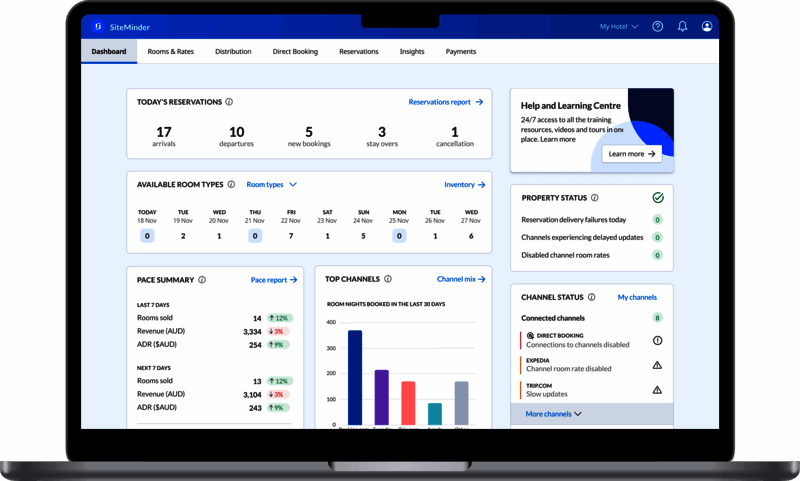
Siteminder is the leading hotel commerce platform, connecting hotels to hundreds of booking channels worldwide through a many-to-many integration layer. Like many companies at their stage, years of growth had left the integration layer complex, costly to maintain and difficult to scale — a new integration or a change to an existing one required significant manual effort, and the compounding technical debt made everything slower and more expensive.
The Challenge
Siteminder had designed a new event-driven architecture to systematise and automate their integrations — making it faster to build new ones, easier to maintain existing ones and simpler to upgrade shared components across the board. The challenge was proving the business case: how long would it actually take to migrate existing integrations and deliver new ones under the new architecture? They needed a proof of concept with a high-calibre offshore team capable of working within a sophisticated, event-based system — and the discipline to deliver it well.
Our Approach
Pragmateam established an offshore team to work alongside Siteminder's engineering and architecture leads, with two onshore leads managing day-to-day delivery and acting as the bridge between teams. Before any work began offshore, the team came onshore for an onboarding period — pairing with Siteminder engineers, learning the architecture first-hand, and building direct relationships with the CTO, chief architect and key developers. Those relationships proved essential once the team was working remotely.
The offshore team worked within Siteminder's event-driven framework to migrate existing integrations and deliver new ones, tracking insights and proposing process improvements throughout. Ways of working were disciplined and transparent — the offshore team was treated as a full part of the Siteminder engineering organisation, not a separate unit operating at arm's length.
The Impact
The proof of concept achieved what it set out to do: give Siteminder real, ground-level data on the effort involved in migrating and building integrations under the new architecture. As the team worked through it, the true complexity of the event-driven system became clear — the work was significantly more involved than the business case had anticipated, making continued investment difficult to justify at that scale. Siteminder made the informed decision to take a different path, ultimately establishing their own offshore delivery centre which has since grown to hundreds of engineers.
The engagement demonstrated that even highly complex, architecture-heavy integration work can be done effectively with an offshore team — provided the onboarding, relationships and ways of working are right.
